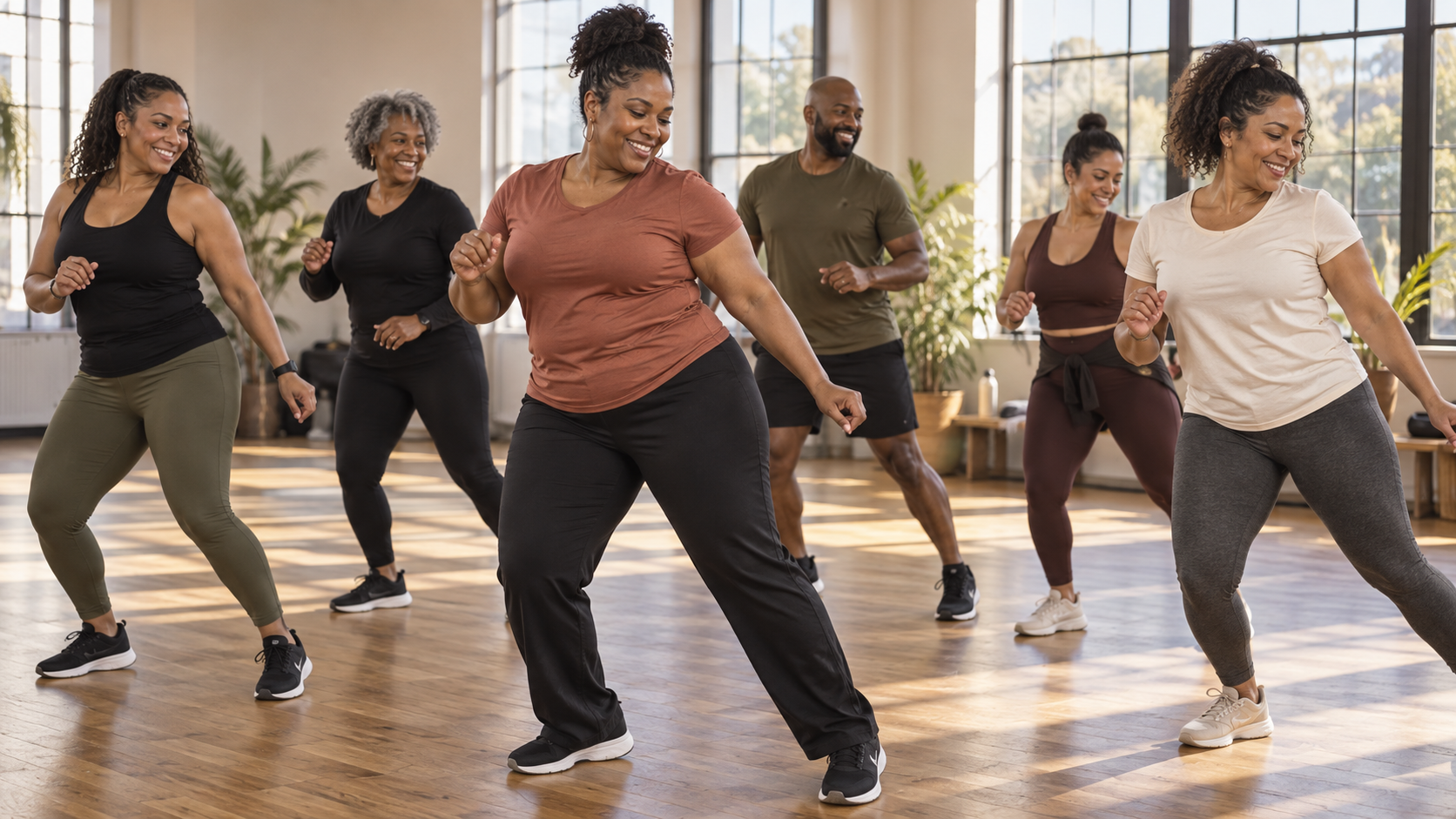
Put on the right song and a room fills itself. You have seen it at a cookout, a wedding, a family reunion, in front of a festival stage. Nobody sends an invitation. The intro drops, and people who have never met are on the same count inside a minute.
Concrete Fit™ is what happens when you take that pull and build a full fitness hour on it. It is the signature line dance fitness program of Concrete Steppas™: guided from the front, structured from warm-up to cool-down, and set to the music a room already loves.
Heart Rates UP… Steps DOWN.
The music is the reason people stay
Line dance is everywhere right now, and it got there on the strength of the music. Soul, R&B, hip-hop, go-go, house, country, Afrobeats, Caribbean music, soca, Latin, Afro-Latin, reggae, reggaeton, and more. The songs that pull people out of their chairs at every family function. Concrete Fit™ comes out of that culture and brings it with it, on purpose.
The most durable names in group fitness were built on the same idea: take music people already love and turn it into an hour anybody can follow. The workout is real. The reason people come back on a Saturday morning is that it does not feel like one.
A class, and a format
A great class depends on the person teaching it. When that instructor is on, the hour is wonderful, and it rises and falls with their taste, their energy, and their week.
A format is built to be more durable than that. It has a structure that holds in a room of twelve or two hundred. It has a shape a newcomer can feel by the second week and count on by the fourth. Its intensity is designed in rather than improvised on the spot. And it can be taught to someone who was not in the room when it was made, and still be itself when they teach it.
Concrete Fit™ was built as a format from the start, so that it can travel well beyond the people who made it.
What an hour holds
The shape stays the same from week to week, which is what lets people get better at it instead of just attending it.
It opens with a warm-up that gets ankles, knees, hips and shoulders ready to work. Then come the foundations, the handful of building-block steps that every routine is assembled from, so that nothing later in the hour arrives as a complete stranger. The bulk of the hour is the routines themselves: full line dances, layered on a piece at a time, taught so people are moving long before they have it perfect. A short cardio push takes the heart rate up. A cool-down and stretch brings everybody back.
Three settings, one room
Every routine runs at three intensities. A low-impact setting that is joint-friendly and open to a first-timer. A middle setting that gets you sweating. And a higher setting for anyone who wants to be worked. Modifications for knees, hips, shoulders and balance are part of how the routines are taught, rather than something announced as an exception at the front of the room.
What that produces is a room where everybody is doing the same dance at the same time at the setting that is right for them. Nobody is parked in a beginner corner. The person going hardest and the person going easiest are both on the count, and from the middle of the floor you cannot always tell which is which.
Everybody on the same count
Someone in their twenties looking for a workout that gets results without an extreme training program will find it here, and will be surprised how hard an hour of this is. Someone coming back to exercise after time away will find it here too, and will be surprised how much they can do in the first class.
They are in the same room, on the same count, missing the same turn and laughing about it. Nobody is being measured against anybody else, and that mix is a big part of why people come back.
There is a deeper story inside that, about memory and movement and staying sharp for a long time, and it has its own collection here under Sudoku for the Body™.
Why the repetition turns into a release
The usual worry about a structured class is that it will get boring. What happens is closer to the opposite, and it has more to do with music than with fitness.
A dance you half know is work. A dance you know is a release. The first couple of times through a routine you are concentrating. Somewhere around the fifth time your body has it and your attention is free, and that is when you get the thing people chase in exercise and rarely find: you are working hard and you are not thinking about working hard. You are in the music, with a room full of people doing exactly what you are doing.
A new routine every week never gets you there. Repetition does, and the format exists to make that repetition dependable without letting it turn into the same hour on a loop.
Built portable
Concrete Fit™ needs a floor, sound, and room to move. No equipment to buy, nothing to install.
Follow our Luma calendar for upcoming sessions, events, and locations.
Explore Concrete Fit™ for your organization
Founders of Concrete Steppas™
Precious “Preciosa” Myers-Brown, KV Simmons, Dr. Danielle “Tonie” Tyler, and M’Balia “Bella” Rucker.
Based in National Harbor, Maryland.