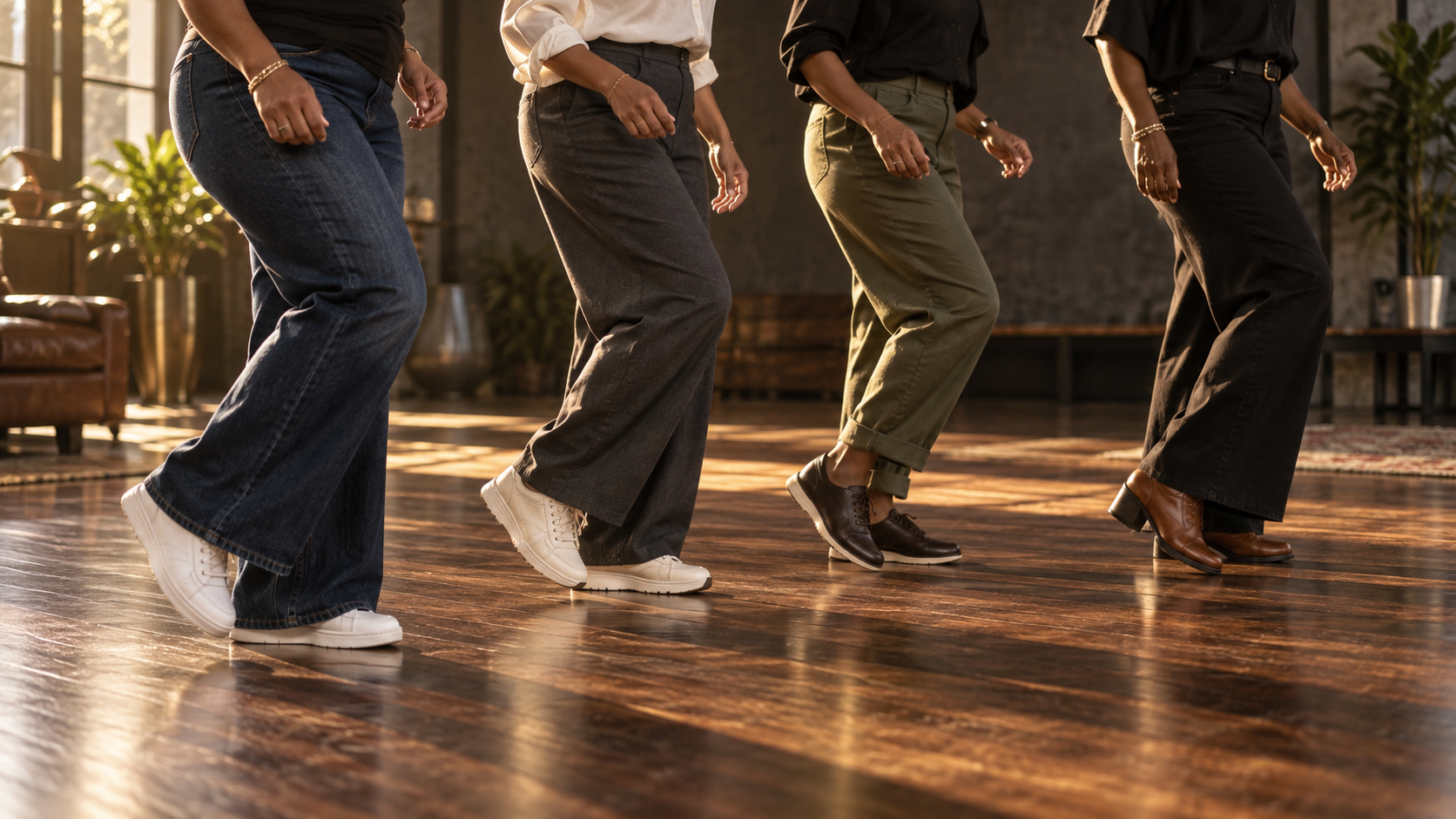
Play four seconds of an intro. Do not announce anything, do not demonstrate anything, just let the first bar land and watch a room that knows that song.
Shoulders set. A foot slides back before anybody has thought about it. People who would have told you a minute ago that they did not remember this one are on the count, and their faces say they are as surprised as you are.
The remembering is the exercise. Not a pleasant side effect of the exercise. The thing itself.
We call it Sudoku for the Body™. It is a guided line dance session, and what it works is the loop between hearing something, holding onto it, and getting your body to answer.
What the remembering asks of a person
Say the name of a dance and a body has to produce the answer. Not describe it, not nod at it, produce it, in sequence, on the beat, with the right foot.
That is a fuller job than it looks. You are holding a pattern while the count keeps running, keeping your place inside it, and turning what you know into something your hips and feet are actually doing. Then the routine turns you a quarter of the way around and the wall you were using to orient yourself is behind you, so the cues you had been leaning on have to be found again without stopping.
All of that happens at tempo, in a body that is warm and moving through its full range. Listening, recalling, sequencing, moving, finding your place again. That is the session.
The techniques
People assume something like this runs on one trick. It runs on a set of techniques, most of them long familiar to anyone who teaches movement, and the craft is knowing which one a particular room needs at a particular moment. These are the ones we use.
Calling it while they are doing it. The most common one. We name the step out loud as it happens, in time, over the music. Grapevine right. Back, two, three. Turn. The instruction and the movement arrive together, so a person hears the name of the thing at the moment their body is making it, and over enough passes the two fuse. Later the name alone will pull the movement out.
Naming the dance and waiting. Once a routine has a name attached, the name becomes a handle. We say it, and we hold off. You can watch people reach for it. That two-second reach is the repetition that matters most, and demonstrating too quickly is what takes it away from them.
Taking the picture away. Sometimes we cannot tell whether a person has the sequence or is keeping up with the front of the room. Following along is real participation and we have nothing against it, but it does not answer that question, and it does not give them the reach. So we close our eyes and take it in words. Two steps to the right. Two steps to the left. Open your arms wide, and hug yourself. With nothing to copy, what is left is what a person heard and can hold. It is one technique among several, used when it fits the room, and nobody is required to do it.
Layering instead of explaining. We do not stop and describe a routine from the top. Eight counts go into the body, we run it, we add eight more, we run the whole thing. The sequence gets built underneath people while they are already moving.
Slowing it down. When a room loses the thread, dropping the tempo while keeping the count alive usually beats starting over, because it lets people find their place inside something that is still going. There are moments when stopping is the right call and a good instructor makes it. Most of the time, slowing is what keeps a room in it.
What we are building
A library a body can reach into on its own.
A body keeps what it is regularly asked to keep, so we ask for range on purpose. Reaching wide, turning all the way around, stepping back when the instinct is forward, getting low and coming up, weight moving side to side and then front to back. Then we attach names and songs to all of it, so there is a way back in.
A movement you can only produce while somebody is showing you stays in that room with that instructor. A movement that comes back when you hear four seconds of a song goes home with you.
What the research says
We read in this area because it is adjacent to what we do, and it is worth being specific rather than waving at it.
A review in Aging Clinical and Experimental Research gathered thirteen studies covering 1,605 adults aged sixty and over, some randomized trials and some not, and looked at what dance did for cognition. It found benefits on global measures of thinking and reported that dance may benefit memory. It also found that the result for executive function did not hold once a weaker study was set aside. The authors' own summary is appropriately careful: dance may be a safe and effective approach to improving cognitive function in older adults.
Research on dance and cognition informs our approach. Sudoku for the Body™ is our contribution to putting that learning into practice, bringing music, memory, and movement together to help people build habits for aging well.
Who this is for
Anybody who would like their body to keep a bigger library than it is currently keeping.
That takes in more people than the description first suggests. Somebody in their thirties whose day is screens and split attention is doing the same work in this session as somebody who has been moving for sixty years and plans to keep going. The instructor adjusts pace and range to the room in front of her, and nobody gets sorted into a category on the way in.
It belongs in active aging and senior programming, and it belongs there strongly, because a session built on listening rather than sightlines works in rooms where sightlines are difficult. It runs standing and it runs seated, and we set those choices with whoever is hosting before the day, so the format fits the room instead of the room having to fit the format.
Aging well does not begin on a particular birthday.
Say the name. See what your body does.
Founders of Concrete Steppas™
Precious “Preciosa” Myers-Brown, KV Simmons, Dr. Danielle “Tonie” Tyler, and M’Balia “Bella” Rucker.
Based in National Harbor, Maryland.