Think about how most teams actually spend time together now. A grid of faces on a screen. A conference table with everyone half on a laptop. A ballroom with a facilitator, a deck, and a few hundred people who were polite for an hour and then went back to their rooms. Those settings are good at moving information around, and we use them ourselves. What they rarely build is the thing every leader says they want more of: people who trust themselves, and who trust each other.
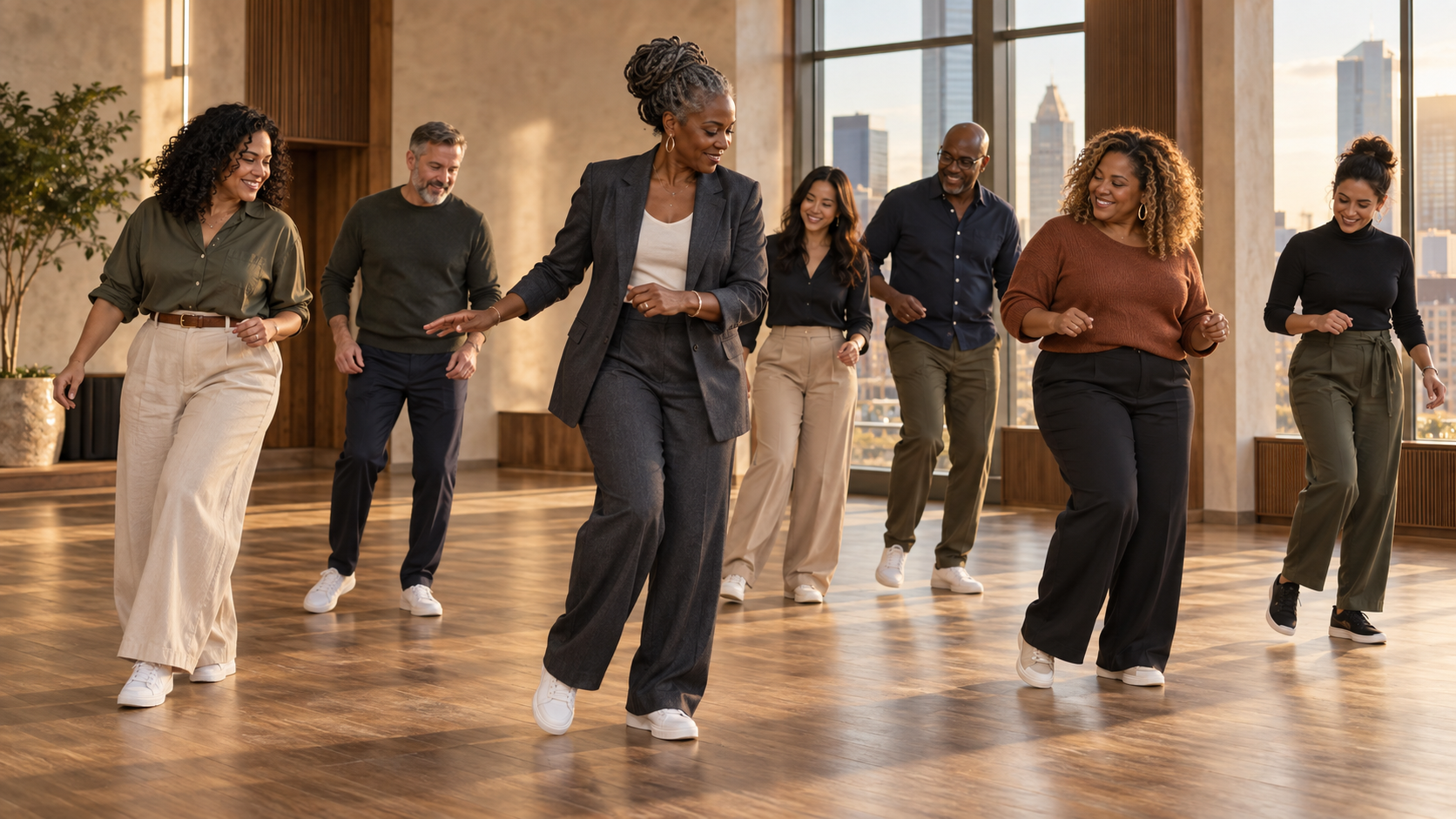
Trust the Step™ is a facilitated leadership development, team-building, and corporate wellness experience from Concrete Steppas™, using line dance, shared learning, and reflection to help organizations strengthen human connection. It gets people out of the screen-staring moment and into a shared experience, in the same room, on the same count.
We begin with the person. Self-development, self-leadership, and self-empowerment come first: learning how you listen, how you respond to something unfamiliar, and how you encourage yourself to try again. Each person grows at their own pace, with coaching and encouragement from the people around them. As you build trust in yourself, you have more to bring to the team.
Here is how it starts. A step gets called once, over the music, while the count is already running. A room full of people who have never done it hear it. Some of them have decided they cannot do this before the sentence is even finished. Then the room starts to move, and within a few passes people who were sure they would stand at the back are in it.
That is not the warm-up for the real work. That is the work.
Five things, inside the same eight counts
We teach five things. They are not five modules and they do not happen on five separate days. They happen inside the same stretch of music, over and over, until they stop being ideas somebody explained and become something people have already done with their own bodies. We are writing all five down here because a buyer should know exactly what happens in the room before she brings us into it.
Hear the call
The step is named one time, at tempo, and the music keeps going.
This is usually the first thing a room notices about itself. Listening turns out to be work, and it happens against a clock. In most of our week the clock is generous enough that we never find out how much we actually heard. On the floor you find out right away, and when someone misses the call they can feel exactly where they lost it. Nobody is being tested to be embarrassed. It is just visible, which is a piece of information a slide cannot give you.
If you lead a team, the small version is simple: after you give an instruction that matters, ask someone to say back what they heard, right then, before the meeting moves on.
Process on the move
The space between hearing something and doing something is where a lot of time goes missing at work.
On the floor that space is measured in counts. The music keeps moving, and each pass gives you another opportunity to connect what you hear with what you do. You can pause, observe, and rejoin when you are ready. The aim is to build your ability to respond with greater confidence through practice. You are learning how you learn, finding your footing, and giving yourself permission to grow.
Trust the step
This is the one the experience is named for.
Moving your body in front of other people can feel awkward, and that awkwardness does not land evenly. It runs along culture, age, body size, how athletic somebody was told they were as a kid, and how much of their working life depends on always looking like they have it together. It can feel familiar to someone who has held back in a meeting even when they had something valuable to contribute.
Encouragement matters. So does the opportunity to try, to notice what you are learning, and to try again. On the floor you can take a step before you have perfected it, supported by coaching and a room that makes space for learning. That is self-leadership in practice: choosing your next step, asking for help when you need it, and recognizing your own progress. You have something concrete to build on because you were there.
Recover in rhythm
Everybody misses. What matters is what a miss costs.
On the floor a missed step does not have to cost you the song. You find the beat and come back in. A room full of people missing steps, laughing together, and finding their way back gives everyone a chance to practice responding to a mistake without making it the whole story.
There is something in it for whoever is leading, too. When one person loses the step, the instinct is to stop everything and fix it. Sometimes that is exactly right. Sometimes keeping the count alive, offering a cue, and letting them find their way back in supports their growth. The facilitator models encouragement, and the group practices responding with patience rather than ridicule. That response is the connection to psychological safety: how we treat someone while they are learning matters.
Move as one
And then, at some point, the room lands together.
Nobody announces it. You can hear it, because a room hitting the same beat sounds different from a room getting close to it. That moment is what the whole hour is built toward: people who walked in as coworkers standing near each other, turning into a group that just did something together.
Confidence in yourself is the first half of what we build. Confidence in each other grows as people practice listening, learning, and encouraging one another. The connection to work becomes useful when the team names what helped and chooses how to carry it forward.
The words your organization already uses
We keep both vocabularies, because the people who bring us in have to explain us to someone.
| What happens on the floor | What your organization probably calls it |
|---|---|
| Hearing the call | Listening, clear communication |
| Processing on the move | Decision-making, execution |
| Trusting the step | Confidence, initiative |
| Recovering in rhythm | Psychological safety |
| Moving as one | Team cohesion |
Trust the Step™ intentionally connects what people practice on the floor with the capabilities organizations need: listening, judgment, initiative, constructive responses to mistakes, and coordination. Self-leadership is the starting point. How each person learns and responds becomes part of how the team works together.
From the floor to the next meeting
Guided reflection helps people make that connection. What helped you understand the instruction? What did you tell yourself when you missed a step? How did the people around you respond? What helped you try again?
Then we bring it back to work. A team might choose to check understanding before moving on, make room for someone to ask a question, or respond to a mistake in a way that helps the person recover. The takeaway is something people can practice in their next meeting or shared task. Individual growth gives the team something to build on.
The joy is not the soft part
People leave these rooms happy. Loud, sweaty, laughing, a little proud of themselves, and talking to people they did not talk to that morning.
That is easy to treat as a nice extra. It is not. A team that has had a good time together, doing something that felt hard at first, has a shared experience it can draw on at work. A joyful workforce is a business asset, and it is one of the few that cannot be bought directly. It has to be built in a room.
The music is a big part of why. It comes from the culture we live in, soul and R&B and hip-hop and the songs that fill the floor at every family function, and we bring it in as it is. Nobody has to be convinced to have a good time to it.
Why we write the method down
We would rather you know exactly what you are getting. Everything above is how we teach, and anyone can read it.
What cannot be read off a page is the room itself: the people calling the steps, who have lived inside this music and this culture long enough to read a room full of strangers in the first minute and adjust to it. The page is how you understand it. The room is where it happens.
What this is, and what it is not
We facilitate an experience people can take part in. No dance experience is required. We discuss participation options with your organization ahead of time, and people can pause, observe, and rejoin as they learn. The point is growth, with room for different starting points.
This is not therapy, and it is not a fix for a structural problem. If two leaders want different things, an hour on their feet together will be a good hour and the disagreement still needs attention when they return to work.
What it does is take something that looked impossible at the start of the hour and make it doable by the end, with the right coaching and the right support in between. The person who learns that walks differently afterward. So does the team.
Bring Trust the Step™ to your organization
For companies, public agencies, and institutions seeking stronger connections across roles, more confident participation, and opportunities for teams to learn together, Trust the Step™ offers a place to begin. It can be part of a leadership program, team retreat, conference, or workplace wellness initiative.
Organizations interested in piloting the experience are invited to discuss their goals, their people, and the challenges they want to address. Together, we can agree on participation needs and how to gather feedback and document learning from the pilot.
Explore a Trust the Step™ pilot
Read more in the Trust the Step™ collection.
Founders of Concrete Steppas™
Precious “Preciosa” Myers-Brown, KV Simmons, Dr. Danielle “Tonie” Tyler, and M’Balia “Bella” Rucker.
Based in National Harbor, Maryland.